


Room 25 is B2 class. It has 6 beds and like the rest of Ward 46 is incredibly busy. Nurses and doctors scurry along the long and not so wide corridor, entering and exiting the 26 rooms, while a few beds with patients in them line the passage way. There is not so much noise in Room 25 although off and on, you hear a shrill cry coming from the room next door. It is a cry of pain.


There is no toilet in Room 25. Everyone in Ward 46 shares a common patients-only toilet outside in the corridor. The room is air-conditioned but yet has a ceiling fan above every bed. It looks modern and well-equipped. Each bed is automated and can even take the weight of the patient lying down. Against the head wall of each bed is a white board, with specific notes regarding each patient, but none was updated that day. The view through the window of Room 25 is impressive, but except for visitors near the window, no one bothered. The patients, when unattended, either just sleep or lie in bed watching the goings-on, preoccupied more with their lives than the view.
Ward 46 is no ordinary ward.

THE ROUTINE
At about 2.30 pm, a gang of uniformed staff accompanied by a trolley enters the room. It is handover time for a new shift. Someone, pointing to a computer screen on the trolley, talks and others take notes. It is probably about each patient’s details and medication schedule; maybe habits or peculiarities which the computer records don’t tell.


The ward is now swarmed with activity. Male and female staff of various ethnicities (Chinese, Malay, Indian, Filipinos) move around to attend to most of the patients. Some for their medical needs and some for simple requests like food, drinks or the toilet. Others offer words of comfort.
Room 25 has only male patients.
BED 1
Looking at least 70+, he came to the room 5 days ago after a stroke. Head drooped to one side he looks like he is asleep most of the time, with no noise except occasional grunts. He takes no solid food, fed with liquid in a tube through his nose. Restraint gloves are in both hands to prevent him sub-consciously pulling the tube out of his face. Regularly, he has to be hooked onto a machine to help him clear phlegm from his throat. But you can see his open eyes when you walk past him, and he is awake.
BED 2
He lost one kidney after a cancer bout 20 years ago. Now 72, he has stomach cancer. He looks alert, acknowledges visitors, and seems like a very nice guy. Good mannered, he converses well in English. But he too cannot eat and has to be tube-fed. Today is his 8th and last day in Room 25, and he has to move upstairs to the hospital’s cancer unit for chemotherapy. Someone visited and after a moving discussion, he says he will make his own decision. Whatever that is, it was too much to bear for the grief-stricken visitor.
The bed emptied but soon enough came a 30-ish medium-sized heavy guy who had not been able to shit for a few days. He speaks crassly over his hand phone and walks around with half his underwear exposed. And just like him, his 2 female visitors had this same unfriendly snobbish air about them. He left after 3 days. Maybe he could finally shit while in Room 25.
Next came a 63 year-old with a heart problem straight from work. He was still in his uniform and hard black work shoes. No one came with him. Soon after he calls someone over the phone, and from the conversation it sounded like his wife, a young wife. Of the 6 patients at that time, he was the most mobile. He will put on his heavy-set work shoes that he came in with, and which he keeps under his bed, and walks out the room on his own, maybe to the toilet. There are no hospital-provided shoes or slippers, other than your gown. He asks for food every now and then, and even when he is not supposed to drink, he asks for coffee. If not attended to, he laments why there is no food, and what if he dies before he gets his next meal. Even with air-conditioning, he has his fan above him turned on. Whether related to his illness or not, he frequently clears his throat ever so loudly and then spits into a plastic bag. And the young nurses are at his beck and call. With the curtain pulled round his bed, it is difficult to know what physiotherapy treatment they give him. In the 2 days since he checked in he had one visitor who stayed 5 minutes. No one saw the wife, unless she came late at night.
BED 3
The 87 year-old has dementia and Parkinson’s since 5 years ago. He is here after suffering a lumbar fracture from a fall. The man is hardly awake, as he lies there quietly not asking for anything and not disturbing anyone. There is constantly a family member there for him, to feed him and to watch over him. Quite regularly, when someone visits, he will be nudged and asked if he recognises the visitor. Maybe it helps exercise his faculties or maybe it is to say so-and-so has come to pay respects. Sometimes he mistakes someone for another, but hopefully he can appreciate the visitations.
Initial tests showed low blood count and he needed transfusions. Then they noticed he had blood in his diapers, so they checked him for piles but none, and finally a scope was done. Almost 10 days after admission, they say he has a tumour in his intestines. It is stage 4 and has spread to the liver. The doctors and family members discuss. The tumour is blocking processed food through to the rectum. If he eats, things will pile up upwards. It is not an easy decision, and they finally opt for stoma surgery without touching the tumour.
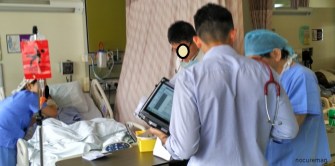
The day before surgery, 4 doctors visited him. They asked him to move his limbs one by one, open and close his mouth, and tested other functions, presumably to assess his suitability for surgery. A dentist visited later to check his dental condition, whether there were any loose tooth that might have to be removed prior to the operation. When you go under general anaesthetics at this age, anything can happen. There are many things to do, answer questions, fill forms, explain the risks, get ready blood for transfusion, and then the long anxious wait.
The stoma took just about an hour to do but in all it took 4 hours before he was wheeled out of the operating theatre, out of immediate danger and into a high dependency ward in another block. No need for ICU and no more Ward 46.
BED 4
He looked 90+ years of age, and just out from a gallstone operation. The nurse sets up a drip for him. Conscious and alert, he asks what is in the drip. He has poor vision and cannot see what is on the wall clock nearby but he wants to know the time of day. 2 doctors came by to check and talk to him. They seem to know his condition well and they talk to him like they know him personally as well. Whatever happens, he appears to be in good hands.
BED 5
He moved into the ward after 5 weeks in another hospital and is now in Room 25 for more than 12 days, the longest stay by anyone this far. His hair is almost all gone and he is all skin and bones. Presumably very weak he never leaves his bed, and his voice is not so audible you have to strain your ears to understand him. He is 70+ and has Parkinson’s too but we don’t know what else. Like BED 2, he is always enquiring about food, and is quite particular about it, complaining why it is always the same, pushing away some meals and asking instead for biscuits, and wanting no rice but porridge. At visiting hours, a lady came and brought some noodles for him. Finally it is something he has been craving to eat, and he is so happy. The noodles certainly made his day.
BED 6
Just 40, the man had been shitting blood for a month. The young wife came while he was out for some tests. She was probably really tired as she took over the bed, covered herself with the blanket and slept soundly for like 2 hrs. No one bothered as under the sheets she looked just like any other patient. 2 days later, he was discharged. An operation has been scheduled but he has to wait at home.
After they changed the bed sheets, someone in his late 60s arrived with a heart problem. He sounded educated and he was not in a good mood. Someone tried to offer him some water but he snapped back. Maybe it is the room or the company, but obviously he hated to be in Room 25. After 2 days, he too left to wait out his operation.
Barely 1 hr later, with a further change of sheets, another man was wheeled in, wife and maid in tow. He was able to rattle off his IC and name. His feet had stumps, ravaged by diabetes. He, wife and maid rattled off his condition to the nurse.
Another patient, another case, another life.
NOCUREMAN:
If we ever fall seriously ill, we just could end up in a ward 46. Most people will anyway. What will we be thinking about lying there, how long will we stay, will we suffer pain, will our loved ones come every day, can we get our favourite meals, will we be cured or will we be fearing death? Can it be a blissful sleep oblivious to what may happen? By that time, it probably won’t matter anymore.
The hospital staff will go about their jobs. They will smile and will be nice. Doctors will try their best. Friends and family will visit. But at the end, it is only us who lie there, some hoping for a miracle and some biding their time. A few will get out. Whatever will be, will be, but it will come to everyone one day.


 nocureman